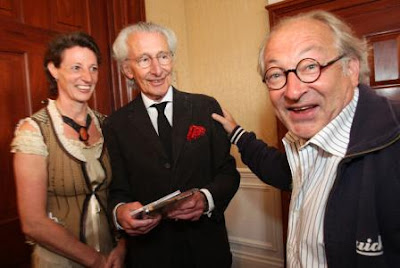
I've just finished reading
The Assault by Harry Mulisch (the more dapper of the two gentlemen in the photo), an excellent novel which deserves a wider readership. Born in 1927, Mulisch has an interesting background. His father was an Austrian-born Nazi collaberator who spent three years in prison after the Second World War. Mulisch's mother, however, was Jewish.
Mulisch once joked that he
was the Second World War and in many respects,
The Assault is the work of a writer trying to reconcile himself with his mixed inheritance. Set between 1945 and 1981, this novel manages to say an awful lot in its 180-odd pages. I hope that this European classic doesn't disappear into the ether of obscure fiction in translation.
This is the third great novel I've read by a Dutch writer in as many months and yet Holland hasn't exactly set the literary world on fire. Why is this? There are many possible answers, but none of them are entirely satisfactory and if you apply the same criteria to other countries (weighting the results according to population and number of people speaking the relevant language) the results vary wildly.
Why has the Czech Republic produced so many world-class writers compared to Poland, Switzerland or Finland, for example? Why have France and Russia contributed more to world literature than Germany and Italy?
If you take the English-speaking world, although every relevant nation has produced a good crop of writers, for some reason Ireland and Canada are head and shoulders above everyone else. The number of great Irish writers is particularly impressive when you consider that Ireland's population is 2% of the USA total.
But I'm rambling. My point is this: is there a thriving literary tradition in Holland waiting for an enlightened Anglophone publisher to share it with an English-speaking audience, or are Harry Mulisch and W.F.Hermans big fish in a very small stream?
If Antal Szerb's wonderful
Journey by Moonlight could be regarded as a classic of Hungarian literature for 60 years before anyone bothered to translate it, then that would suggest that we have a lot to look forward to.
 On a whim I stopped my car and walked into this church. Like every other medieval church I've been to recently, it was stunning. I almost wish I wasn't a heathen.
 People like to complain about the declining standards of written and spoken English as if there was a golden age, but 300 years ago things were far worse. Every church I go in seems to have different spellings of everyday words.
 This is Bewl Water - a reservoir on the Sussex-Kent border. It almost looks as if Excalibur should appear out of the water
 I have no idea what this antiquated mobile phone (or is it a pager?) is doing in the middle of a wood. It's striking how impotent and pointless technology looks in this setting.
 This is a teabag in a holly bush. I don't know why either.
 Young love
 Spring
 Transplant this sign to certain parts of London and I suspect that it would be a little controversial...


