When I ran a bookshop I never had any problem recruiting people. Even a post-it note stuck in the bottom corner of a window would yield a deluge of applications, nearly all from students. I have ruined many a young graduate's life by luring them into a life of penury in the book trade.
However, I'm now in a warehouse on a remote industrial estate. Any stray visitors are hunted down like dogs, so I've had to rethink my note in the window strategy.
This time I've used Job Centre Plus. I'm not sure what the 'plus' bit means, but they were very helpful and placed my advertisement for a 'Book Specialist'. The job description specified that I was looking for a book lover with a good general knowledge and keyboard skills.
Today I received this letter - a masterpiece of brevity:
Dear Mr -,
I am witting (sic) this job application for the book specialist job. I have local knowledge of the area as I have lived here all my life. I am good with people and have done FOOD MANUFACTURING. I used to work in a butchers shop and do home delivering.
Yours sincerely -
He starts on Monday.
Thursday, August 06, 2009


Wednesday, August 05, 2009
Heads or Tails?
Should I try and write something witty, incisive and interesting, or just cut and paste a few YouTube clips?
Tails, you win:
Tails, you win:
Monday, August 03, 2009
New Towns
In June I wrote this post about a fairly hideous place called Mostecko. It is, or at least was, a new town development built in communist Czechoslovakia around 30 years ago. Unless you're a big fan of concrete, it's a pretty unappealling place. However, the authorities obviously regarded it as the apotheosis of their ideology and published a lavish photographic book, celebrating the creation of their socialist utopia.
The post prompted several comments and the general consensus was that planned towns don't work. For a community to succeed, it has to grow organically over many generations, in response to the needs of its inhabitants, rather than the blinkered vision of social engineers and the greed of corporations.
But is this really true? Edinburgh's 'New Town', built between 1765 and 1850 is a masterpiece of urban planning, as is Baron Haussmann's redevelopment of Paris during the reign of Louis Napoleon. Will Mostecko achieved belated acclaim in the 23rd century? I somehow doubt it.
Last week, during a holiday in Dorset, I made a detour to visit Poundbury, a controversial new 'urban extension' of Dorchester. It is controversial because the driving force behind Poundbury is Prince Charles, the bette noire of modern architects. This is what I found:


 The idea behind Poundbury is to create a 'market town' environment with an ecclectic mix of architectural styles, but beneath its traditional trappings, this development has been heavily influenced by America's 'New Urbanism' movement, which promotes walkable, unzoned areas.
It would be so easy to criticise Poundbury. Where are the people? I felt as if I was in an episode of The Prisoner. Also, it really goes against the grain to see any new building that has been designed by someone who has tried to pretend that the 20th century never existed.
However, the fact remains that if I had to choose between living in Mostecko, Crawley, Milton Keynes, Basildon, Stevenage or Poundbury, I'd choose the latter without hesitation. Poundbury may be a pastiche (and if I lived there, I'd probably feel as if I was in The Truman Show), but the uncomfortable truth is that Prince Charles's vision of a people-centered urban space, built using traditional methods and designs, is far superior to any of Britain's postwar new towns.
Saturday, August 01, 2009
Holiday Snaps
I have just returned from a week's caravan holiday in Dorset. I don't think there's any need to go into further detail - it's one of those statements like 'I've just spent the last three months being held hostage in Iraq' or 'I'm going to have my left leg amputated' which requires no further comment.
Here are some holiday snaps:
 This is the beach at Lyme Regis. The parents in this photo managed to sunbathe and spend ages chatting on their phones without any interuption from their children. The boy seemed content to either stare into space or watch his sister build a sandcastle. What's their secret?
My sons are feral and the oldest one had to be rescued by the coastguard within an hour of arriving at the beach.
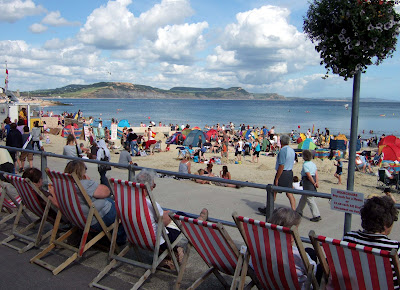 Ever since I was a boy, I've looked forward to the days when I can play Crown Green bowls and sit in deck chairs at holiday resorts.
 This couple sat on the table behind us in a beachside restaurant. I love observing couples in restaurants, particularly unusual ones like these two. They sat largely in silence, but whether it was companionable or awkward I couldn't tell. The long tress of hair suggests that a day of wholesome hiking will be followed by an evening of violent lovemaking.
 In the great tattoo debate, I'm firmly on the non side and I'm afraid that I saw nothing to change my views. What might look sexy on a young woman in her early twenties, looks increasingly unapealling with age and weight.
On Lyme Regis beach I found myself yearning for an impromptu raid from the Tehran Morality Police. There are only so many beer guts and varicose veins that a person can look at.
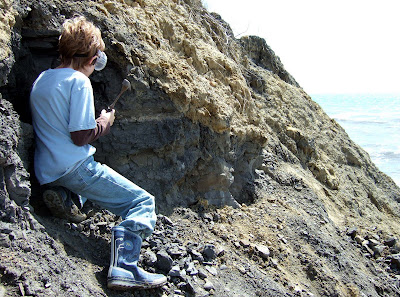 The fossil-rich Dorset coastline is now a UN World Heritage site. Unfortunately, my son's idea of fossilling consists of hitting the cliff face as violently as possible with a large hammer.
 The origins of the 'Rude Man of Cerne Abbas' are uncertain. Is he a prehistoric fertility figure? Is his bellicose stance a warning to other tribes? There is no written reference to him before 1647 and it is possible that he is a 17th century joke.
 I found this 12th century effigy in the beautiful Lady St Mary's church in Wareham. He looks surprisingly cheerful for a dead medieval knight. The church is full of interesting features, including an 8th century Celtic inscription (see below) and a salmon-shaped weather vane.

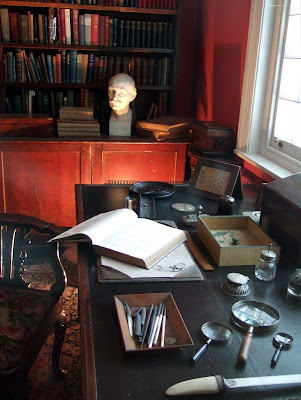 This replica of Thomas Hardy's study is a permanent exhibition at the excellent Dorset County Museum in Dorchester. With the possible exception of the Santa Barbera Museum of Art, this is the best small museum I've ever visited.
The Museum concentrates on the county's archeological, geological and literary heritage, the latter of which includes features on Thomas Hardy, John Cowper Powys, Sylvia Townsend Warner, John Meade Falkner and the local dialect poet, William Barnes:
The girt woak tree that's in the dell !
There's noo tree I do love so well;
Vor times an' times when I wer young
I there've a-climb'd, an' there've a-zwung,
An' pick'd the eacorns green, a-shed
In wrestlen storms from his broad head,
An' down below's the cloty brook
Where I did vish with line an' hook,
An' beat, in playsome dips and zwims,
The foamy stream, wi' white-skinn'd lim's.
The Dorset dialect is virtually dead, but I once heard a teenage girl say 'Oi bain't' (I be not) to a baffled French exchange student. There may still be pockets of Dorset dialect in some of the remoter 'Squeak like a piggy' parts of the county, but it's unlikely. Even the lovely rural burr is dying out (for non-British readers, the traditional Dorset accent sounds a little like pirates - 'Ha-harr, me hearrties', etc).
However, when the gentleman below was alive, the English language didn't even exist.
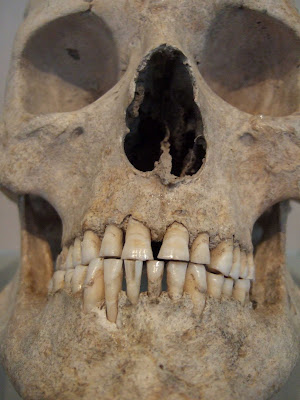 This 4th century skull is one of many skeletons excavated from Dorset's hill forts. One is displayed lying as he was found, with his sword by his side, possibly after a skirmish with the Romans. I'm not sure how I'd feel ending up as a display in a 37th century museum.
 This is part of an 8th century fresco and serves as a reminder of how wonderful English churches must have been before the Reformation saw these craven images smashed up and painted over.
 This carving comes from four centuries later. I like the rouged cheeks.
Like many small museums, although there were themed displays, there were also some quirky artifacts that the curactors had inherited from an earlier, more ecclectic age. I really enjoyed the displays of stuffed red squirrels and Victorian washing devices, but couldn't quite muster up the same enthusiasm for the farming implements.
Museums like the British Museum or the Louvre are all well and good, but they are so vast that the visitor ends up feeling exhusted and drained within an hour. I prefer a good small museum any day.
I didn't think my visit could get any better, but then I found this exhibition:
 A Ladybird exhibition, complete with original art work, jacket designs and activities to keep my children quiet. Bliss!
I like Dorset. I probably liked it even more when I lived in London and the sight of rolling hills and blue seas was a rare treat, but I still feel excited when I see the Cobb at Lyme Regis. However, I will not be going there again for a few years.
Whilst we were cowering behind a wind break on Charmouth beach last Tuesday, my wife and I concluded that unhappy parents are not good parents. My ideal holiday involves good weather, decent accommodation, nice food and a mixture of stimulation and relaxation. Our caravan holiday provided bad weather, plastic accommodation, a constipation-inducing diet of microwaveable ready meals and a mixture of anxiety and exhaustion.
Britain may be back in favour as a holiday destination, but next year we shall be heading for sunnier climes.
Here are some holiday snaps:
 This is the beach at Lyme Regis. The parents in this photo managed to sunbathe and spend ages chatting on their phones without any interuption from their children. The boy seemed content to either stare into space or watch his sister build a sandcastle. What's their secret?
My sons are feral and the oldest one had to be rescued by the coastguard within an hour of arriving at the beach.
 Ever since I was a boy, I've looked forward to the days when I can play Crown Green bowls and sit in deck chairs at holiday resorts.
 This couple sat on the table behind us in a beachside restaurant. I love observing couples in restaurants, particularly unusual ones like these two. They sat largely in silence, but whether it was companionable or awkward I couldn't tell. The long tress of hair suggests that a day of wholesome hiking will be followed by an evening of violent lovemaking.
 In the great tattoo debate, I'm firmly on the non side and I'm afraid that I saw nothing to change my views. What might look sexy on a young woman in her early twenties, looks increasingly unapealling with age and weight.
On Lyme Regis beach I found myself yearning for an impromptu raid from the Tehran Morality Police. There are only so many beer guts and varicose veins that a person can look at.
 The fossil-rich Dorset coastline is now a UN World Heritage site. Unfortunately, my son's idea of fossilling consists of hitting the cliff face as violently as possible with a large hammer.
 The origins of the 'Rude Man of Cerne Abbas' are uncertain. Is he a prehistoric fertility figure? Is his bellicose stance a warning to other tribes? There is no written reference to him before 1647 and it is possible that he is a 17th century joke.
 I found this 12th century effigy in the beautiful Lady St Mary's church in Wareham. He looks surprisingly cheerful for a dead medieval knight. The church is full of interesting features, including an 8th century Celtic inscription (see below) and a salmon-shaped weather vane.

 This replica of Thomas Hardy's study is a permanent exhibition at the excellent Dorset County Museum in Dorchester. With the possible exception of the Santa Barbera Museum of Art, this is the best small museum I've ever visited.
The Museum concentrates on the county's archeological, geological and literary heritage, the latter of which includes features on Thomas Hardy, John Cowper Powys, Sylvia Townsend Warner, John Meade Falkner and the local dialect poet, William Barnes:
The girt woak tree that's in the dell !
There's noo tree I do love so well;
Vor times an' times when I wer young
I there've a-climb'd, an' there've a-zwung,
An' pick'd the eacorns green, a-shed
In wrestlen storms from his broad head,
An' down below's the cloty brook
Where I did vish with line an' hook,
An' beat, in playsome dips and zwims,
The foamy stream, wi' white-skinn'd lim's.
The Dorset dialect is virtually dead, but I once heard a teenage girl say 'Oi bain't' (I be not) to a baffled French exchange student. There may still be pockets of Dorset dialect in some of the remoter 'Squeak like a piggy' parts of the county, but it's unlikely. Even the lovely rural burr is dying out (for non-British readers, the traditional Dorset accent sounds a little like pirates - 'Ha-harr, me hearrties', etc).
However, when the gentleman below was alive, the English language didn't even exist.
 This 4th century skull is one of many skeletons excavated from Dorset's hill forts. One is displayed lying as he was found, with his sword by his side, possibly after a skirmish with the Romans. I'm not sure how I'd feel ending up as a display in a 37th century museum.
 This is part of an 8th century fresco and serves as a reminder of how wonderful English churches must have been before the Reformation saw these craven images smashed up and painted over.
 This carving comes from four centuries later. I like the rouged cheeks.
Like many small museums, although there were themed displays, there were also some quirky artifacts that the curactors had inherited from an earlier, more ecclectic age. I really enjoyed the displays of stuffed red squirrels and Victorian washing devices, but couldn't quite muster up the same enthusiasm for the farming implements.
Museums like the British Museum or the Louvre are all well and good, but they are so vast that the visitor ends up feeling exhusted and drained within an hour. I prefer a good small museum any day.
I didn't think my visit could get any better, but then I found this exhibition:
 A Ladybird exhibition, complete with original art work, jacket designs and activities to keep my children quiet. Bliss!
I like Dorset. I probably liked it even more when I lived in London and the sight of rolling hills and blue seas was a rare treat, but I still feel excited when I see the Cobb at Lyme Regis. However, I will not be going there again for a few years.
Whilst we were cowering behind a wind break on Charmouth beach last Tuesday, my wife and I concluded that unhappy parents are not good parents. My ideal holiday involves good weather, decent accommodation, nice food and a mixture of stimulation and relaxation. Our caravan holiday provided bad weather, plastic accommodation, a constipation-inducing diet of microwaveable ready meals and a mixture of anxiety and exhaustion.
Britain may be back in favour as a holiday destination, but next year we shall be heading for sunnier climes.
Subscribe to:
Posts (Atom)
