Sunday, August 31, 2008
Why I'm addicted to the X Factor...
I know it's shameful and I always feel dirty afterwards (and not in a nice way either), but I have become mildly addicted to the X Factor. I don't care who wins the competition. I watch it for moments like this, when a contestant is completely barking. If you're one of the unlucky few who hasn't seen this contestant, you're in for a treat:


Wednesday, August 27, 2008
Go East
I have said some very unkind things about East Anglia over the years, including a tasteless remark about melting ice caps and rising sea levels to someone who lived on the Suffolk coast. I'm not sure why I feel such strong animosity towards the area as there are far worse places in Britain, but I think that the relentlessly flat landscape, Siberian winds and uninviting shingle beaches represent the antithesis of everything I enjoy about the countryside.
However, I am unable to ignore East Anglia as my mother-in-law lives there. As I have mentioned before, she lives opposite a decommissioned nuclear power station. In her town, every other person seems to have had cancer and yet nobody ever suggests a link with the 'low-level' radioactive waste that was poured into the sea. They must be in denial.
Last week I went back to East Anglia for a few days and decided to explore Suffolk. At first the signs weren't good: Welcome to Constable Country.
Apart from the appalling idea of 'branding' a whole area, I don't like Constable's paintings and had no urge to see chocolate box scenes like The Hay Wain (which is remarkably unchanged since Constable painted the view). However, the landscape soon changed into a mixture of undulating hills, tranquil woodland and beautiful villages. I was completely unprepared for this and soon realised that I'd have to revise my opinions.
I stopped at a village called Stoke-by-Nayland. It was barely a village, with just a handful of houses, many of which looked as if they were at least 500 years old. On the one hand I was impressed by this beautiful Tudor house:

But it was impossible to disassociate this image from the idyllic scenes that feature in jigsaw puzzles, biscuit tin lids and calendars: This England. In reality, all too many English villages are largely made up of cheap, badly designed bungalows, inhabited by neckless locals who have been priced out of the decent houses by 'incomers'. That's progress.
I walked to the local church and was amazed by its size. In Sussex, the Downland churches are generally very small and intimate in proportion to the villages they serve. However in Suffolk the tiniest village or hamlet can have a huge church:
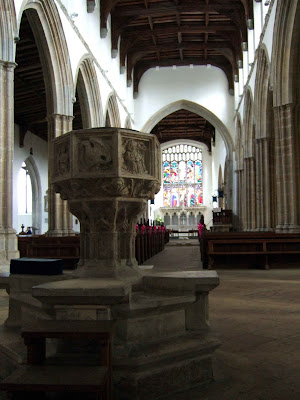 Apparently, Stoke-by-Nayland has a 'wool church' - in other words, a church that was financed by the boom in the wool trade during the fifteenth century.
I love looking around old churches. Apart from the sense of history, they are a bullshit-free environment (if you discount the ultimate bullshit of believing in a non-corporeal creator of everything) in a world that has become demeaned by advertising and branding.
However, although I'd like to claim an interest in ecclesiastic architecture, my main interest in village churches is the glimpses they give of life in the local community. This bulletin board highlights some of the local fundraising events and its star performers:


What is Roy Tricker doing? It looks as though a particularly traumatic episode of constipation has reached its resolution, but perhaps he's just speaking in tongues.

'A Talent to Amuse'? They may not be married but there is some sexual chemistry going on, isn't there?

A big fish in a small stream?

This photo looks as if it was taken in 1975.

Ah, William Fry, the stalwart of the local amateur dramatic society. Who could forget his solo performance of Henry V in 1990, which raised £47.90 for the church roof fund?

I mock, but in fact this was a stunningly beautiful area with an architectural embarrassment of riches. I had no idea that East Anglia contained these hidden gems and from now on, I resolve to be more open-minded.
However, I am unable to ignore East Anglia as my mother-in-law lives there. As I have mentioned before, she lives opposite a decommissioned nuclear power station. In her town, every other person seems to have had cancer and yet nobody ever suggests a link with the 'low-level' radioactive waste that was poured into the sea. They must be in denial.
Last week I went back to East Anglia for a few days and decided to explore Suffolk. At first the signs weren't good: Welcome to Constable Country.
Apart from the appalling idea of 'branding' a whole area, I don't like Constable's paintings and had no urge to see chocolate box scenes like The Hay Wain (which is remarkably unchanged since Constable painted the view). However, the landscape soon changed into a mixture of undulating hills, tranquil woodland and beautiful villages. I was completely unprepared for this and soon realised that I'd have to revise my opinions.
I stopped at a village called Stoke-by-Nayland. It was barely a village, with just a handful of houses, many of which looked as if they were at least 500 years old. On the one hand I was impressed by this beautiful Tudor house:

But it was impossible to disassociate this image from the idyllic scenes that feature in jigsaw puzzles, biscuit tin lids and calendars: This England. In reality, all too many English villages are largely made up of cheap, badly designed bungalows, inhabited by neckless locals who have been priced out of the decent houses by 'incomers'. That's progress.
I walked to the local church and was amazed by its size. In Sussex, the Downland churches are generally very small and intimate in proportion to the villages they serve. However in Suffolk the tiniest village or hamlet can have a huge church:
 Apparently, Stoke-by-Nayland has a 'wool church' - in other words, a church that was financed by the boom in the wool trade during the fifteenth century.
I love looking around old churches. Apart from the sense of history, they are a bullshit-free environment (if you discount the ultimate bullshit of believing in a non-corporeal creator of everything) in a world that has become demeaned by advertising and branding.
However, although I'd like to claim an interest in ecclesiastic architecture, my main interest in village churches is the glimpses they give of life in the local community. This bulletin board highlights some of the local fundraising events and its star performers:


What is Roy Tricker doing? It looks as though a particularly traumatic episode of constipation has reached its resolution, but perhaps he's just speaking in tongues.

'A Talent to Amuse'? They may not be married but there is some sexual chemistry going on, isn't there?

A big fish in a small stream?

This photo looks as if it was taken in 1975.

Ah, William Fry, the stalwart of the local amateur dramatic society. Who could forget his solo performance of Henry V in 1990, which raised £47.90 for the church roof fund?

I mock, but in fact this was a stunningly beautiful area with an architectural embarrassment of riches. I had no idea that East Anglia contained these hidden gems and from now on, I resolve to be more open-minded.
Wednesday, August 20, 2008
Please shoot me before this happens...
From a recent edition of the Exeter Express and Echo:
 The Who were right.
 The Who were right.
Tuesday, August 19, 2008
Cloud on Silver

I've just finished reading John Christopher's Cloud on Silver (US title Sweeney's Island) and find it hard to understand why this gripping novel is out of print. I can only hope that when Penguin republish The Death of Grass next year, there will be a renewed interest in Christopher's backlist.
Without wishing to give too much of the plot away, the novel is about a group of people who are shipwrecked on a desert island in the Pacific and are disturbed to find creatures that appear to be malformed or mutated. The island clearly holds a secret and at first, the survivors plan to explore the mysterious, cloud-covered mountain that overlooks them. However, instead of pulling together they become increasingly distracted by power struggles and sexual tensions.
If I had to describe Cloud on Silver in fewer than ten words, I say that it was like Lost meets Lord of the Flies. Indeed, the similarities to Lost are so striking at times, that I can't help wondering if any of the series' creators have read Christopher's novel. The random appearances of non-native species and the sense that the island itself is a living entity are common to both, although Cloud on Silver is ultimately more down to earth.
John Christopher's novels place ordinary people in extraordinary situations, stripping away the veneer of civilisation to reveal the darker side of human nature. At times Christopher's vision seems excessively bleak, but to know what ordinary people are capable of we only have to look at recent history, particularly Bosnia and Rwanda.
Cloud on Silver isn't literary fiction and it has many flaws, but the sum is greater than its parts and the novel is as prescient as it is dated. Christopher's views of gender, race and society are old fashioned, but we should not dismiss him for being a product of his time.

Cloud on Silver would make a fantastic movie, although I suspect many people would mistakenly assume that it was a rip-off of Lost!
Subscribe to:
Posts (Atom)
