This comes from 'The Shadow of Happiness', by Betty Manvers:
'MIRANDA MARKHAM, who has lived all her life in a London suburb with her father, never travelling any further than the coast for her annual holiday, suddenly learns that her mother, who she has always believed died when she was very young, is the talented concert pianist Miriam Sarelle. Miriam has been mauled by a lion while on safari in Africa, and the radio reports that her right arm has had to be amputated. Gerald Markham, Miranda's father, asks her to go out to Africa to Miriam, who he feels will be in need of someone of her own. He has never ceased to love her since she left him twenty years previously. The first person Miranda meets on arrival at Livingstone is Brett Craybourne, the big game hunter who has organized the safari on which Miranda had been hurt; she falls in love with him, but realises that there is little hope of her love being reciprocated...'
It sounds a corker.
I'm glad that Miriam managed to hang on to the left arm. At least she could still perform this piece:
Tuesday, August 09, 2011


Wednesday, August 03, 2011
The Roaring Twenties
The 1920s might have roared for some people, but probably not for the subjects of a photo album I found yesterday:
 Although I was born in the 1960s, this image feels very familiar to me. When I was a boy, there was a shoe shop in the road next to mine that had been opened by two brothers in the 1930s. It occupied the ground floors of two adjacent houses. One half contained a shoe repair workshop, where the brothers could usually be found; the other contained a showroom with countless boxes of shoes. I used to buy my Clarks Commandos there.
The workshop was like a time capsule. Nothing had been changed for 50 years and the fixture and fittings were all painted in a shade of brown that had probably become obsolete in 1949.
Even when the brothers were in their seventies, they continued to work, buffing leather shoes over ancient lathes. They finally retired in the early 1990s.
 I love this idyllic photograph for so many reasons. It was about to be binned, so I'm very glad that it will now be seen by more people than ever.
 I receive lots of old photograph albums at work. Many contain nothing more than snapshots which are of little interest to anyone; but the best have images that are either historically or artistically appealing. This photo may just be the work of an amateur who was having an 'artistic moment', but it doesn't deserve to be consigned to oblivion.
 Is that graffiti? So much for the good old days.
 This is a slightly creepy photograph: a man who looks like a waxwork dummy and a woman holding a doll. Very odd.
 This is a bit of a Caspar David Friedrich scene, with the protagonist squaring up against the forces of nature.
 This is a rare, naturalistic 'Monday is washday' scene. No Sunday best here.
 A ridiculously large hat.
 The first recorded sighting of a Kindle.


 This is a very touching photo (assuming that rabbit stew was not on the menu).
 This pensive pose is an early example of flash photography (look at the shadow in the background).
 This Danny Kaye lookalike would have loved a full-blown Hammond organ. Perhaps he lived long enough to see one.
 Finally, a picnic scene. The location and identity of these people will always be a mystery - I wish that I could transport myself back there, as they look as if they're having fun.
When I was 20, I met an elderly Welsh farmer on the outskirts of Lampeter. He looked at me and said "Ydych yn siarad Cymraeg?"I replied that I knew a little (I'd worked in a Welsh-speaking pub during the National Eisteddfod of Wales), but it would be a very limited conversation. He immediately switched to English and, like a man possessed, told me that I must sort out my photos:
"Write the names and dates on the back of all of your photographs. I've got albums and I don't know who they are. It's gone. Forgotten. I can't tell my sons who these people are. They're strangers. You need to write everything down."
I promised him that I wouldn't forget and I'm glad that the internet has given me the opportunity to repeat this man's sage advice.
 Although I was born in the 1960s, this image feels very familiar to me. When I was a boy, there was a shoe shop in the road next to mine that had been opened by two brothers in the 1930s. It occupied the ground floors of two adjacent houses. One half contained a shoe repair workshop, where the brothers could usually be found; the other contained a showroom with countless boxes of shoes. I used to buy my Clarks Commandos there.
The workshop was like a time capsule. Nothing had been changed for 50 years and the fixture and fittings were all painted in a shade of brown that had probably become obsolete in 1949.
Even when the brothers were in their seventies, they continued to work, buffing leather shoes over ancient lathes. They finally retired in the early 1990s.
 I love this idyllic photograph for so many reasons. It was about to be binned, so I'm very glad that it will now be seen by more people than ever.
 I receive lots of old photograph albums at work. Many contain nothing more than snapshots which are of little interest to anyone; but the best have images that are either historically or artistically appealing. This photo may just be the work of an amateur who was having an 'artistic moment', but it doesn't deserve to be consigned to oblivion.
 Is that graffiti? So much for the good old days.
 This is a slightly creepy photograph: a man who looks like a waxwork dummy and a woman holding a doll. Very odd.
 This is a bit of a Caspar David Friedrich scene, with the protagonist squaring up against the forces of nature.
 This is a rare, naturalistic 'Monday is washday' scene. No Sunday best here.
 A ridiculously large hat.
 The first recorded sighting of a Kindle.

 This is a very touching photo (assuming that rabbit stew was not on the menu).
 This pensive pose is an early example of flash photography (look at the shadow in the background).
 This Danny Kaye lookalike would have loved a full-blown Hammond organ. Perhaps he lived long enough to see one.
 Finally, a picnic scene. The location and identity of these people will always be a mystery - I wish that I could transport myself back there, as they look as if they're having fun.
When I was 20, I met an elderly Welsh farmer on the outskirts of Lampeter. He looked at me and said "Ydych yn siarad Cymraeg?"I replied that I knew a little (I'd worked in a Welsh-speaking pub during the National Eisteddfod of Wales), but it would be a very limited conversation. He immediately switched to English and, like a man possessed, told me that I must sort out my photos:
"Write the names and dates on the back of all of your photographs. I've got albums and I don't know who they are. It's gone. Forgotten. I can't tell my sons who these people are. They're strangers. You need to write everything down."
I promised him that I wouldn't forget and I'm glad that the internet has given me the opportunity to repeat this man's sage advice.
Monday, August 01, 2011
Island Life
I have just returned from a slightly odd five-day trip to the Isle of Wight, house-sitting for a complete stranger that my wife had met through Mumsnet.
My oldest son didn't want to go. After years of being warned about the dangers of chatting to strangers online, he was convinced that we were being lured to our deaths by a Belgian psychopath. It was only when I casually mentioned that the house had a Wii and Xbox that he began to change his tune.
The last time I went to the Isle of Wight I was six months old. Several people commented that very little had changed since my last visit. Of course this isn't true, but the four miles of water that separates the Island (as the locals refer to it) from the English mainland does give the place a very separate identity, almost as if it inhabits an alternate reality.
It's not quite Britain in the 1950s, but it doesn't feel like the 21st century either.
Here are a few things I loved about the Isle of Wight:
1. The walk to the Needles Old Battery:
 It's almost a mile from the car park to the Victorian coastal defence at the southwestern tip of the island - not a huge distance, but enough to deter the hoi polloi from ruining the tranquil atmosphere.
2. The Isle of Wight Railway:
 Where else would you find a 1938 tube train in the middle of the English countryside? This isn't a 'heritage' line for tourists, but a genuine passenger service, using reconditioned London Underground rolling stock.
The journey from Ryde begins in a long tunnel and for a minute, listening to the the familiar clunks and whirs of the electric motors, it feels as if you're on the District Line approaching Sloane Square. When the train emerges into the English countryside, the juxtaposition of such unlikely elements feels like a very strange dream:

London Underground stations look nothing like this.
Or this:
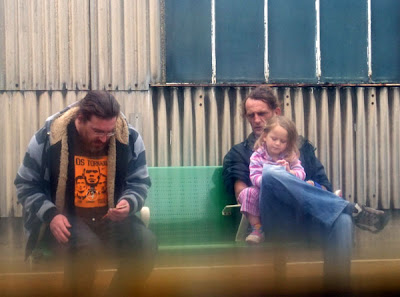
3. Red Squirrels:
 You can't see them, but they can see you. Unlike their big, brash American cousins, who now dominate the mainland, the native British squirrel is petite and discreet. I had to wait patiently in some dense undergrowth before I was rewarded with my David Attenborough moment: a red squirrel (tiny little thing) resting on a branch, making a series of strange squeals and clicks.
The next day I nearly ran one over.
I expect the BNP like the Isle of Wight. It's almost entirely white working class (I struggled in vain to find my favourite brand of balsamic vinegar), with very few of those annoying, Guardian-reading London types like me who push the property prices up with their art galleries and organic cafes. Even the squirrels are thoroughly British.
4. The Roman Villa in Newport:
 Actually it's quite boring and I feel sorry for anyone who has got excited by the brown sign announcing a 'Roman Villa', only to find themselves looking at a floor. It's a very nice floor, with lots of impressive mosaics, but it's not a villa. I'm sure that people have been prosecuted for less misleading descriptions.
However, what I liked about the Roman villa in Newport is its incongruous location, situated in a dull-looking bungalow in a quiet residential road, a few doors down from the house we were staying in. Apparently the villa strays into next door's garden, but the previous owners didn't want to ruin their patio and it remains buried to this day.
5. Osborne House
 This was Queen Victoria's favourite residence because it provided a sanctuary from a world in which she was routinely "mobbed by crowds", enabling her to enjoy a relatively normal life with her husband and children.
The coast of mainland England is visible from the gardens, but reassuringly distant:
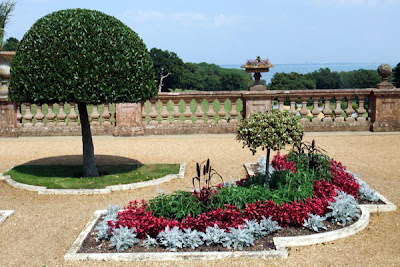 The interior of the house wasn't my cup of tea: hideously opulent furnishings and objets d'art, complemented with badly-lit, poorly-executed oil paintings by forgotten masters. It didn't help that I kept bumping into an annoying mother and daughter, who made loud, confident pronouncements like "They didn't have magazines in the Victorian times."
The daughter was probably ten years younger than me, but every time we reached a staircase she wheezed and complained with each step. Instead of advising her daughter to eat fewer doughnuts, the mother agreed.
I had almost given up hope of seeing anything I liked, but Queen Victoria's bedroom more than made up for the disappointment of the rest of the house. To see the bed where Victoria died and look up at the ceiling decorations that she must have stared at countles times was very moving. I tried to imagine the scene - only 110 years ago - in which the dying Queen was attended to by her servants, physician and loved ones, but just as I started to lose myself, the mother and daughter appeared:
"Oh yes, she was a very respectful lady..."
Fortunately they didn't stay long. But as they left, two attendants decided to begin a detailed comversation about their dogs' health and the resulting vet bills. I gave up.
One other thing I liked about Osborne House was the gallery devoted to Indian nobles. It looked as if Queen Victoria took her role as Empress of India very seriously, devoting several rooms to portraits of maharajas and artifacts from the subcontinent.
I had no idea that Victoria went to great pains to learn Urdu and a display case showed a page from an exercise book in which she had written several passages in the local script. Perhaps the recent memory of the Indian Mutiny had prompted a more respectful attitude on the part of the British.
But even if you don't like vulgar, excessively ornate 19th century interiors, Osborne House is worth visiting for the beauty of its grounds. The formal gardens had an idyllic, arcadian quality; like a ruined Greek temple:
 However, at the edge of the grounds through a gap in the trees, I caught a glimpse of my true arcadia:
 6. Carisbrooke Castle:
 There isn't much to say about Carisbrooke Castle; it's just a beautiful place with a wonderful panorama of the surrounding countryside. Charles I was held prisoner here after Parliament had won the English Civil War and although it can't have been a terribly happy time for him, at least he had a room with a view:
 After exploring the grounds, I went to the tea shop and ordered a cup of tea and a slice of cake (it's a rock n'roll life). Instead, I got a pot of tea and a huge wedge of Victoria sponge. No wonder there's an obesity crisis.
I've noticed that portions have doubled in size over the last 20 years, with a standard packet of crisps going from 20g to 40g. I can understand why this has happened: a manufacturer who sells a 15p slice of cake for £1.70 can now sell a 30p wedge of Victoria sponge for £3.40, making almost £2 additional profit for doubling the portion.
But the end result is that I'm stuck on a staircase behind a 30 year-old woman who is wheezing like a consumptive war veteran. It's not good.
In the tea shop, I was joined by a couple who spoke in a loud nasal accent about how "taahribly entrahsted" they were in the Castle's past:
"In Tennesse we met a chap who claimed that he was descended from one of the signatories of Charle's I's death warrant. He seemed convinced that because of this he wouldn't be allowed into England and nothing we said could change his mind..."
There was a pause.
"Still, perhaps he wouldn't be let in for other reasons! Hwah, hwah, hwah!"
I was happy in Carisbrooke Castle, but all my sons wanted to do was go back to the house and continue playing with the Wii. My youngest son complained that "you're taking us out all the time. This is the worst day of my life since the start of the world."
It was very frustrating to realise that all my sons wanted to do was stay in and play computer games. I'd vaguely entertained the idea of buying a Wii - I'd fallen for the marketing spiel about getting families to play together, but it's bollocks. All of these games suck the imagination dry, replacing original thought with predetermined scenarios and ghastly soundtracks that repeat the same leitmotifs, ad nauseum.
Worst of all, I was also becoming addicted to the Wii. When, on the last morning, I realised that I was the first person to wake up, I crept downstairs to see if I could beat the high score in Wii Sports. I'd developed a genuine dislike of a character called Martin, who kept stopping me get to the next level. I had a score to settle with him:
 But I haven't completely lost hope. I'd say that the moment when we were all at our happiest was on a summer's evening, walking along the cliff tops to the Old Needles Battery. Away from the distractions of the Wii and the temptations of 'family' theme parks (our one vist to a theme park lasted for a mere 15 minutes, as a girl vomitted in front of us within 10 seconds of arriving and my son got stung by a bee), we managed to find our 'mojo'.
Sometimes the best things in life are free.
My oldest son didn't want to go. After years of being warned about the dangers of chatting to strangers online, he was convinced that we were being lured to our deaths by a Belgian psychopath. It was only when I casually mentioned that the house had a Wii and Xbox that he began to change his tune.
The last time I went to the Isle of Wight I was six months old. Several people commented that very little had changed since my last visit. Of course this isn't true, but the four miles of water that separates the Island (as the locals refer to it) from the English mainland does give the place a very separate identity, almost as if it inhabits an alternate reality.
It's not quite Britain in the 1950s, but it doesn't feel like the 21st century either.
Here are a few things I loved about the Isle of Wight:
1. The walk to the Needles Old Battery:
 It's almost a mile from the car park to the Victorian coastal defence at the southwestern tip of the island - not a huge distance, but enough to deter the hoi polloi from ruining the tranquil atmosphere.
2. The Isle of Wight Railway:
 Where else would you find a 1938 tube train in the middle of the English countryside? This isn't a 'heritage' line for tourists, but a genuine passenger service, using reconditioned London Underground rolling stock.
The journey from Ryde begins in a long tunnel and for a minute, listening to the the familiar clunks and whirs of the electric motors, it feels as if you're on the District Line approaching Sloane Square. When the train emerges into the English countryside, the juxtaposition of such unlikely elements feels like a very strange dream:

London Underground stations look nothing like this.
Or this:

3. Red Squirrels:
 You can't see them, but they can see you. Unlike their big, brash American cousins, who now dominate the mainland, the native British squirrel is petite and discreet. I had to wait patiently in some dense undergrowth before I was rewarded with my David Attenborough moment: a red squirrel (tiny little thing) resting on a branch, making a series of strange squeals and clicks.
The next day I nearly ran one over.
I expect the BNP like the Isle of Wight. It's almost entirely white working class (I struggled in vain to find my favourite brand of balsamic vinegar), with very few of those annoying, Guardian-reading London types like me who push the property prices up with their art galleries and organic cafes. Even the squirrels are thoroughly British.
4. The Roman Villa in Newport:
 Actually it's quite boring and I feel sorry for anyone who has got excited by the brown sign announcing a 'Roman Villa', only to find themselves looking at a floor. It's a very nice floor, with lots of impressive mosaics, but it's not a villa. I'm sure that people have been prosecuted for less misleading descriptions.
However, what I liked about the Roman villa in Newport is its incongruous location, situated in a dull-looking bungalow in a quiet residential road, a few doors down from the house we were staying in. Apparently the villa strays into next door's garden, but the previous owners didn't want to ruin their patio and it remains buried to this day.
5. Osborne House
 This was Queen Victoria's favourite residence because it provided a sanctuary from a world in which she was routinely "mobbed by crowds", enabling her to enjoy a relatively normal life with her husband and children.
The coast of mainland England is visible from the gardens, but reassuringly distant:
 The interior of the house wasn't my cup of tea: hideously opulent furnishings and objets d'art, complemented with badly-lit, poorly-executed oil paintings by forgotten masters. It didn't help that I kept bumping into an annoying mother and daughter, who made loud, confident pronouncements like "They didn't have magazines in the Victorian times."
 The daughter was probably ten years younger than me, but every time we reached a staircase she wheezed and complained with each step. Instead of advising her daughter to eat fewer doughnuts, the mother agreed.
I had almost given up hope of seeing anything I liked, but Queen Victoria's bedroom more than made up for the disappointment of the rest of the house. To see the bed where Victoria died and look up at the ceiling decorations that she must have stared at countles times was very moving. I tried to imagine the scene - only 110 years ago - in which the dying Queen was attended to by her servants, physician and loved ones, but just as I started to lose myself, the mother and daughter appeared:
"Oh yes, she was a very respectful lady..."
Fortunately they didn't stay long. But as they left, two attendants decided to begin a detailed comversation about their dogs' health and the resulting vet bills. I gave up.
One other thing I liked about Osborne House was the gallery devoted to Indian nobles. It looked as if Queen Victoria took her role as Empress of India very seriously, devoting several rooms to portraits of maharajas and artifacts from the subcontinent.
I had no idea that Victoria went to great pains to learn Urdu and a display case showed a page from an exercise book in which she had written several passages in the local script. Perhaps the recent memory of the Indian Mutiny had prompted a more respectful attitude on the part of the British.
But even if you don't like vulgar, excessively ornate 19th century interiors, Osborne House is worth visiting for the beauty of its grounds. The formal gardens had an idyllic, arcadian quality; like a ruined Greek temple:
 However, at the edge of the grounds through a gap in the trees, I caught a glimpse of my true arcadia:
 6. Carisbrooke Castle:
 There isn't much to say about Carisbrooke Castle; it's just a beautiful place with a wonderful panorama of the surrounding countryside. Charles I was held prisoner here after Parliament had won the English Civil War and although it can't have been a terribly happy time for him, at least he had a room with a view:
 After exploring the grounds, I went to the tea shop and ordered a cup of tea and a slice of cake (it's a rock n'roll life). Instead, I got a pot of tea and a huge wedge of Victoria sponge. No wonder there's an obesity crisis.
I've noticed that portions have doubled in size over the last 20 years, with a standard packet of crisps going from 20g to 40g. I can understand why this has happened: a manufacturer who sells a 15p slice of cake for £1.70 can now sell a 30p wedge of Victoria sponge for £3.40, making almost £2 additional profit for doubling the portion.
But the end result is that I'm stuck on a staircase behind a 30 year-old woman who is wheezing like a consumptive war veteran. It's not good.
In the tea shop, I was joined by a couple who spoke in a loud nasal accent about how "taahribly entrahsted" they were in the Castle's past:
"In Tennesse we met a chap who claimed that he was descended from one of the signatories of Charle's I's death warrant. He seemed convinced that because of this he wouldn't be allowed into England and nothing we said could change his mind..."
There was a pause.
"Still, perhaps he wouldn't be let in for other reasons! Hwah, hwah, hwah!"
I was happy in Carisbrooke Castle, but all my sons wanted to do was go back to the house and continue playing with the Wii. My youngest son complained that "you're taking us out all the time. This is the worst day of my life since the start of the world."
It was very frustrating to realise that all my sons wanted to do was stay in and play computer games. I'd vaguely entertained the idea of buying a Wii - I'd fallen for the marketing spiel about getting families to play together, but it's bollocks. All of these games suck the imagination dry, replacing original thought with predetermined scenarios and ghastly soundtracks that repeat the same leitmotifs, ad nauseum.
Worst of all, I was also becoming addicted to the Wii. When, on the last morning, I realised that I was the first person to wake up, I crept downstairs to see if I could beat the high score in Wii Sports. I'd developed a genuine dislike of a character called Martin, who kept stopping me get to the next level. I had a score to settle with him:
 But I haven't completely lost hope. I'd say that the moment when we were all at our happiest was on a summer's evening, walking along the cliff tops to the Old Needles Battery. Away from the distractions of the Wii and the temptations of 'family' theme parks (our one vist to a theme park lasted for a mere 15 minutes, as a girl vomitted in front of us within 10 seconds of arriving and my son got stung by a bee), we managed to find our 'mojo'.
Sometimes the best things in life are free.
Sunday, July 24, 2011
The Stephen Fry Mystery
This morning, I took my younger son to a rather strange open air museum of industrial archaeology which, given its mostly odd-looking visitors and large collection of redundant machinery, felt like some sort of post-apocalyptic settlement. I liked it.
However, on the way there, I passed somewhere that was far superior in the post-apocalyptic stakes: Shoreham Cement Works. Closed in 1991, the works consist of two huge abandoned factories that look like something out of Tarkovsky's masterpiece, Stalker.
On the western side of a road that cuts through the works, there is an abandoned office building:
 As you can see, there is some writing on the wall under the top row of windows:

'FRY "POSH" BORE'?
Why would somebody go to the effort of breaking into an abandoned factory next to a rural minor road, just so that they could paint an anti-Stephen Fry slogan?
I know that Fry's status as a 'national treasure' isn't universally accepted, but this seems a rather strange form of protest. The only suspect that springs to mind - Simon Gray - died three years ago.
It's a mystery.
Also, haven't they heard of Twitter? Stephen Fry certainly has.

However, on the way there, I passed somewhere that was far superior in the post-apocalyptic stakes: Shoreham Cement Works. Closed in 1991, the works consist of two huge abandoned factories that look like something out of Tarkovsky's masterpiece, Stalker.
On the western side of a road that cuts through the works, there is an abandoned office building:
 As you can see, there is some writing on the wall under the top row of windows:
'FRY "POSH" BORE'?
Why would somebody go to the effort of breaking into an abandoned factory next to a rural minor road, just so that they could paint an anti-Stephen Fry slogan?
I know that Fry's status as a 'national treasure' isn't universally accepted, but this seems a rather strange form of protest. The only suspect that springs to mind - Simon Gray - died three years ago.
It's a mystery.
Also, haven't they heard of Twitter? Stephen Fry certainly has.

Subscribe to:
Posts (Atom)
