A while ago I was going through some new fiction titles with a publisher when I came across a racing thriller by a fairly well-known writer. I noticed that the title was billed as a 'superlead'.
'Sorry, but he doesn't sell as well these days.' I said, ordering a measly three copies.
The publisher's enthusiasm seemed undimmed. 'Well, yes his sales have dropped off recently, but we've changed the ghostwriter and I think that this one should be back on form.'
Sunday, December 03, 2006


Saturday, December 02, 2006
Byzantium
According to the BBC News web site, Pope Benedict's visit to Turkey has been a relative success compared to the complete disaster that everyone was expecting. I almost feel sorry for the Pope. Everyone liked John Paul II because he smiled a lot and knew how to work a crowd. His reactionary views on birth control probably caused thousands of unnecessary deaths and helped the spread of AIDS, but people were content to turn a blind eye to that. However, no-one likes Benedict because he bears such a strong resemblance to the evil Emperor Palpatine from Star Wars:

If you look up religion in the official 2001 population census of Great Britain, several hundred thousand people have declared themselves Jedi Knights. Where are they now?

If you look up religion in the official 2001 population census of Great Britain, several hundred thousand people have declared themselves Jedi Knights. Where are they now?
Friday, December 01, 2006
Bestsellers...
You can imagine the buzz at Michael Palin's publisher when he decided to let them print the diaries he'd kept during the Monty Python era. Bingo! Everyone loves Michael Palin. His travel books always end up in the Christmas top five and this insider's view of the Python years is bound to be the Alan Bennett of 2006. So why isn't it selling?
 To be fair the sales aren't bad by normal standards, but by Palin's this must be a huge disappointment. Why isn't the book in the top five? Perhaps the answer lies in Palin's almost official role as the nicest man in Britain. When I read someone's memoirs I want the sort of scurillous gossip that is almost libelous. Piers Morgan's entertaining Insider is a good example of this and although much of the material seems outrageous and highly suspect, I can only assume that the lack of libel actions means that a large part of it is true. Palin's diaries are far too generous, reasonable and nice to make compelling reading. In fairness I've only read a few entries, but if the book had grabbed me more I'd have read the whole thing by now.
Michael Palin isn't alone. Bill Bryson's memoir isn't setting the bestseller charts on fire, whilst the massively-hyped Billy Piper autobiography Growing Pains is being beaten hands down by Richard Dawkins' polemic against religion. Who says that we're dumbing down?
As far as fiction is concerned, fewer than 10% of my top 50 bestsellers are hardback fiction and the names are all familiar ones: Ben Elton, Andy McNab, Dick Francis and, of course, Terry Pratchett. Publishers paid a fortune in advances for Diane Setterfield and Michael Cox's debuts, but it looks as if it's going to be a long time before they get their money back unless Saints Richard and Judy intervene.
The sports table is also full of surprises. Wayne Rooney was paid a large sum of money for his book and whilst it's ticking along, the sales are nothing compared to Stephen Gerrard's autobiography.
So what is selling? At the moment the bestselling autobiography is Peter Kay's The Sound of Laughter, which is outselling everything else by a long chalk. Other bestsellers include Victoria Beckham's guide to fashion (no it isn't a humour title), Jeremy Clarkson's selected rants vol.2, a humorous book about Latin and, to the surprise of many, Pam Ayres' Surgically Enhanced.
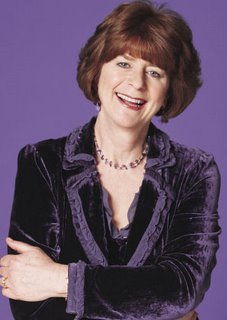
I saw Pam when she first appeared on Opportunity Knocks, so I'm rooting for her.
The Peter Kay biography will be bought by many and read by few. That is the nature of Christmas bestsellers. A few years ago the bestselling book at Christmas was Shane Richie's autobiography. I'd overhear customers saying 'She likes 'im, don't she' and you could sense their relief that they were one present nearer the end of their Christmas shopping(incidentally, research has recently revealed that the average housewife spends 18 hours Christmas shopping!). When the Richie book came out in paperback in time for the summer reading season, we sold fewer than half a dozen. Why? Because no-one actually wanted to read it.
Most years there is one book that takes everyone by surprise. Remember the Politically Correct Bedtime Stories, Magic Eye or Eats Shoots and Leaves? This year's book would have been the saucy Janet and John stories from Terry Wogan's morning show, but sadly nobody seized the opportunity. Another contender is Where's Bin Laden? - a spoof of the Where's Wally? books, but it's still early days.
It looks like it's going to be a late Christmas in the book trade, in which case the likes of Palin, Piper and Bryson still have a chance of earning back their advances.
However, I won't be buying any of these books. I would recommend Peter Ashely's Unmitigated England, which is one of the best books I've seen for a long time. Last year there was a glut of nauseating titles inspired by the dreadful Pocket Book of Patriotism. Unmitigated England is in a class of its own, celebrating things that are uniquely English without ever sinking into sentimental jingoism.
 To be fair the sales aren't bad by normal standards, but by Palin's this must be a huge disappointment. Why isn't the book in the top five? Perhaps the answer lies in Palin's almost official role as the nicest man in Britain. When I read someone's memoirs I want the sort of scurillous gossip that is almost libelous. Piers Morgan's entertaining Insider is a good example of this and although much of the material seems outrageous and highly suspect, I can only assume that the lack of libel actions means that a large part of it is true. Palin's diaries are far too generous, reasonable and nice to make compelling reading. In fairness I've only read a few entries, but if the book had grabbed me more I'd have read the whole thing by now.
Michael Palin isn't alone. Bill Bryson's memoir isn't setting the bestseller charts on fire, whilst the massively-hyped Billy Piper autobiography Growing Pains is being beaten hands down by Richard Dawkins' polemic against religion. Who says that we're dumbing down?
As far as fiction is concerned, fewer than 10% of my top 50 bestsellers are hardback fiction and the names are all familiar ones: Ben Elton, Andy McNab, Dick Francis and, of course, Terry Pratchett. Publishers paid a fortune in advances for Diane Setterfield and Michael Cox's debuts, but it looks as if it's going to be a long time before they get their money back unless Saints Richard and Judy intervene.
The sports table is also full of surprises. Wayne Rooney was paid a large sum of money for his book and whilst it's ticking along, the sales are nothing compared to Stephen Gerrard's autobiography.
So what is selling? At the moment the bestselling autobiography is Peter Kay's The Sound of Laughter, which is outselling everything else by a long chalk. Other bestsellers include Victoria Beckham's guide to fashion (no it isn't a humour title), Jeremy Clarkson's selected rants vol.2, a humorous book about Latin and, to the surprise of many, Pam Ayres' Surgically Enhanced.

I saw Pam when she first appeared on Opportunity Knocks, so I'm rooting for her.
The Peter Kay biography will be bought by many and read by few. That is the nature of Christmas bestsellers. A few years ago the bestselling book at Christmas was Shane Richie's autobiography. I'd overhear customers saying 'She likes 'im, don't she' and you could sense their relief that they were one present nearer the end of their Christmas shopping(incidentally, research has recently revealed that the average housewife spends 18 hours Christmas shopping!). When the Richie book came out in paperback in time for the summer reading season, we sold fewer than half a dozen. Why? Because no-one actually wanted to read it.
Most years there is one book that takes everyone by surprise. Remember the Politically Correct Bedtime Stories, Magic Eye or Eats Shoots and Leaves? This year's book would have been the saucy Janet and John stories from Terry Wogan's morning show, but sadly nobody seized the opportunity. Another contender is Where's Bin Laden? - a spoof of the Where's Wally? books, but it's still early days.
It looks like it's going to be a late Christmas in the book trade, in which case the likes of Palin, Piper and Bryson still have a chance of earning back their advances.
However, I won't be buying any of these books. I would recommend Peter Ashely's Unmitigated England, which is one of the best books I've seen for a long time. Last year there was a glut of nauseating titles inspired by the dreadful Pocket Book of Patriotism. Unmitigated England is in a class of its own, celebrating things that are uniquely English without ever sinking into sentimental jingoism.
Merry Christmas
Although Christmas in retail begins in late October, it feels like a phoney war until someone fires the starting pistol on December 1st. For the next three weeks, the public will engage in an orgy of spending which will be make or break time for the high street chains.
I feel ambivalent about the whole thing. On the one hand I feel disgusted by the way Christmas has become commodified. Seeing crowds of bad-tempered people fighting over goods that will produce a few minutes of pleasure on Christmas Day before being consigned to the attic is a depressing spectacle. On the other hand, I know that if my shop is to survive I need to sell as many unwanted presents as I can, particularly given this year's appalling sales.
With the exception of a few chains - Marks and Spencer for example - there has been a steady downturn in high street sales for the last two years. There are three main reasons for this. First, internet usage has now reached the point where 60% of people shop online. The internet is not only more convenient, but is also usually significantly cheaper. Second, there is more competition from supermarkets. Why make a special trip to a bookshop when you can pick up the latest Jordan biography during the weekly shop? Third, many people have borrowed more than they can afford and are feeling squeezed by repayment charges, rising fuel bills and a hike in interest rates.
I cannot speak for other retailers, but from a bookseller's persective I think that the next few years are going to be very hard. During the last 20 years, over 400 bookshops have opened. Most of them are over 4,000 sq ft and will have a turnover of at least £1,000,000 a year. This has been a great success story and repudiates the view that people aren't reading any more, but now that people can also buy books online or in their local Tesco, how many bookshops will we need?
If my shop's sales continue to decline I can do two things: I can reduce my payroll costs and try and improve my margin from the supplier. However if, after paying for the stock, staff and site, I am making a loss I'm in trouble. Where do I go from there, assuming that I've done everything possible to increase sales?
I'm ashamed to say that in my particular case, I do have another option: I can drive a competitor out of business. I would rather focus on positive things like selling more books, but if that isn't happening then I have to do everything I can to safeguard my staff's jobs.
I am convinced that he next few years will see a lot of closures in the book trade, but at some point the dust will settle because there will always be a need for proper bookshops where people can browse, attend signings and meet authors. The internet can't replace that. As for Tescos, I'll start worrying when they sell Sartre.
Subscribe to:
Posts (Atom)
