Sunday, September 17, 2006

Another triumph from Michael Haneke

I've just watched a brilliant film called 'Hidden' (Cache) by the maker of 'The Piano Teacher', Micheal Haneke.

Haneke isn't your average film director. He didn't make a movie until he was 46, having devoted the first part of his adult life to studying philosophy and psychology at the University of Vienna, followed by working as a film critic, dramatist and director for the stage and television. In Haneke's own words: My films are intended as as polemical statements against the American 'barrel down' cinema and its disempowerment of the spectator.

In 'Hidden' a successful middle-class couple arrive home to find a supermarket carrier bag outside their doorstep. It contains several videotapes. They play one of the tapes and, seeing the front of their house, realise that someone has them under surveillance. More tapes follow, accompanied by threatening drawings done in the style of a child. Who is sending the tapes and, more importantly, why?


'Hidden' is a compelling study of paranoia, guilt and retribution with a suspense that is worthy of Hitchcock. Daniel Auteuil and Juliette Binoche are superb, but equal credit must also go to the supporting cast, particularly Maurice Benichout and Lester Makedonsky, who delivers a superb performance as the couple's teenage son.

As for Haneke, he is true to his word and empowers the viewer with a tantalising (and sometimetimes infuriating) succession of hints and allusions that may or may not be true and by the end of the film, there are more questions than answers. This is the best film I've seen for a long time.

Wednesday, September 13, 2006

Friday, September 08, 2006

Restoration

For a few years I lived in a remote part of Welsh-speaking Wales, studying at the smallest university college in Britain. One day, during a trip to the local shops, an old man came up to me and started talking in Welsh. I apologised for not understanding him and asked him if he spoke English (apparently there are several thousand Welsh speakers in Wales who can't speak English). 'Well the thing is, I've lost my tractor' he replied. 'I came into town for market day and now I can't remember where I've parked it. I don't know what I'm going to do.' I wasn't sure what I could do, but he seemed so old and vulnerable that I felt that I had to help him somehow.

As we walked along the road in pursuit of the missing tractor, the farmer turned to me and said 'You're young. I've got one piece of advice for you.' I waited with bated breath for some piece of life-changing wisdom. 'On the back of a photo, always write the date and names of the people. I've got hundreds of old photographs and I don't know who they're of or when they were taken.' I listened politely, but didn't really take him seriously. A few minutes later we bumped into a friend of his whose expression suggested that this wasn't the first time the tractor had been lost. As we bid each other goodbye, the farmer said 'Remember. Always write the names and dates on your photographs. Diolch yn fawr.'

I never thought about the farmer's words again until last year, when my father died and I discovered boxes full of photos of people I didn't recognise and places I'd never been to. I managed to work out who some of the people were, but there were some who would remain a mystery. Death is so bloody final.

I found one badly damaged photo of a group of soldiers in the First World War and was about to chuck it in the box of unknowns when I realised that one of the men was my grandfather.
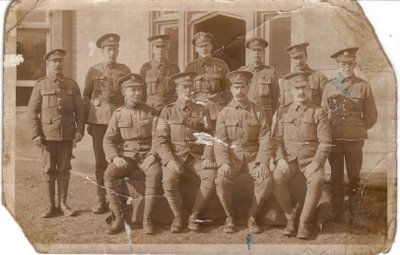

It was sad to see the photo in such poor condition, so I scanned it and cleaned up the image, courtesy of Photoshop. I'm quiet pleased with the result:
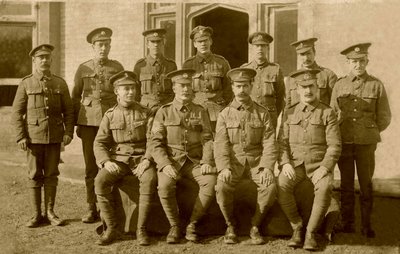

My grandfather is standing at the back, third from the right and must have been a teenager when the picture was taken. During his time at the Front, he would be shot at, gassed and endure hardships that I can only begin to imagine. He joined the army before he had a chance to learn a trade and was never able to achieve his potential, but thanks to his tenacity and determination, Grandad was never out of work.

Grandad was a Cockney 'rough diamond'. He was not an educated man, but gained the respect of others through his honesty and capcity for hard work. At one point he worked on the London Underground and fell on an electric line. He suffered from severe burns but in the 'good old days' he wasn't entitled to paid sick leave and had to take his two-week annual holiday to attend a burns unit. He found a hospital on the coast and took his wife and sons with him so that they could enjoy the seaside whilst he recovered.

During the Second World War he joined the Home Guard. I have no idea how he managed to find the time to do this as he was cycling a round trip of 26 miles a day to work, avoiding the potholes left by the previous night's air-raid. When I sometimes complain about my drive to work I think of Grandad, cycling from Twickenham to Edmonton in the middle of winter and I feel humbled by his example.

But I digress. Returning to the Welsh hill farmer, I am going to belatedly take his advice. I haven't lived long enough to forget the people and places in my photos, but I have seen how frustrating it is to be confronted with a box full of unmarked pictures of people who might or might not be your great-grandparents. I'll start doing it now.

Thursday, September 07, 2006

Doctor Who - the Gay Connection

Yesterday my six-year-old son came home with the latest Doctor Who comic. It comes out every two weeks and it's clear that the production team struggle to come up with new ideas and usually rehash the same photos every third or fourth issue. Luckily, because childhood seems like an eternity, my son never seems to remember.

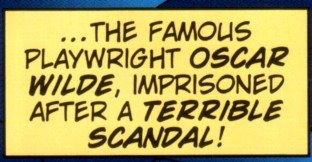
This issue featured the usual assortment of monsters, but there was one radical departure in the form of a comic strip entitled 'The Battle of Reading Gaol'. As soon as I saw the title I did a double-take. It couldn't be, could it? But yes, it was all about Oscar Wilde.

Someone at Doctor Who Comic must have have decided to have a bit of fun and the result is a brilliantly wicked story that must have gone over the heads of 99% of its readers.


Reading my son's comic, I remembered how many gay people I'd met who loved Doctor Who. I once went to a party where everyone had to dress as a character from Doctor Who and I dutifully turned up in costume. The party was in full swing when I arrived, with several Doctors, the Brigadier and a variety of aliens dancing very energetically. I couldn't dance in my costume and decided to move into the garden where I was confronted with the unusual spectacle of seeing two Doctor Whos (William Hartnell and John Pertwee) snogging passionately. It was a rather surreal image.

At this point I realised that the lack of women and choice of music (Sylvester's 'You Make Me Feel Mighty Real') pointed to the fact that this was a very gay affair. I was fascinated. I had always assumed that Doctor Who fans were spotty, heterosexual males who lived with their mothers, but here was whole new subculture that I knew nothing about.

I decided to ask William Hartnell, once he had stopped kissing John Pertwee, why Doctor Who appealed so much. It was, he said, a mixture of things, but it was mainly the fact that here was a hero who wore crushed velvet jackets with frilly shirts, avoided fights and didn't have a girlfriend. He also confessed that he first knew that he was gay when he saw a cyberman at the age of five ('Ooh, they were just so dominant')!

It all made sense and when, over ten years later, the man who wrote the groundbreaking gay drama series Queer as Folk was chosen to revive Doctor Who, I knew that the franchise would be in good hands.