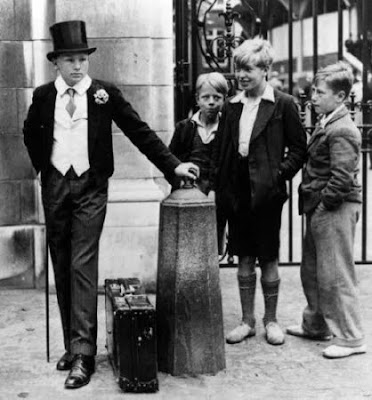
 "It is impossible for an Englishman to open his mouth without making some other Englishman hate or despise him." - George Bernard Shaw
In a recent post about Waterstone's, I made a casual remark about the former managing director and his Estuary accent, unwittingly implying that he was a "bit common" to be leading Britain's largest bookshop chain.
John Self was quick to spot my woolly thinking (it's his job) and asked me exactly what I meant. I began to write what I thought was a coherent, reasonable explanation, but soon realised that I had begun to dig a hole. I deleted my reply and wrote another considered, reasonable response. The hole grew even bigger.
I knew that I was on the wrong track when my wife (who rarely reads this blog), spotted the exchange and said
"I don't know what you're on about, but I agree with John Self".
At this point I started to question myself. Why did I have such a negative attitude towards a particular regional accent? I toyed with the idea of constructing an argument based on the aesthetic qualities of Estuary - but I knew that it would be avoiding the issue.
The unpalatable truth is that I harbour a prejudice - one that has its origins in early childhood.
My parents were both working class, but aspired to move up the social ladder and focused their aspirations on me. As a young child I wasn't allowed to play with the "rough boys" and whenever we walked past Teddington Social Club, my mother would point to the women inside playing Bingo and tell me how "common" they were.
At first I spoke with a
Laahndun accent, but was constantly upbraided for saying "Sa-urday" and "Man Uni-ed" until I developed what my mother still refers to as a "nice speaking voice" ("Joan says you could read the news."). The accent was a mixed blessing. I didn't know any middle-class people and my peers mocked me for being posh.
It would be unfair to imply that my parents brutally crushed any signs of a working-class identity. I was a willing participant. From an early age I made it clear that I prefered Earl Grey and Camembert to PG Tips and Cheddar. Indeed, my nickname in those days was "Little Lord Fauntleroy".
By my teens, I started to mix with middle-class kids and was amazed to find houses full of books and original paintings. It was a revelation. At one friend's house, the room where we played snooker contained the complete Thames and Hudson
World of Art series and, much to my friend's annoyance, I was more concerned with discovering what
Fauvism and
Cubism were.
Suddenly everything - the BBC accent, my interest in the arts and penchant for foreign cheeses - clicked into place. I was middle class. My parents' experiment has succeeded, almost.
So where does the Estuary accent comment come into all of this?
It's complicated, but I think that my parents' obsession with making me speak "properly" left me with a deep-rooted prejudice about the local accent. During my teens I successfully rejected my parents views on race, gender and politics and came to regard myself as a liberal (with a small "l").
Little did I realise that beneath my enlightened exterior, there lurked a bigot!
In the past, there was no such thing as
received pronunciation. We know this, because before spelling was standardised, people wrote phonetically. Then, in the Victorian age, accents began to be linked to social background and that's where all the trouble began.
John Self mischievously asked where he stood with his Belfast accent. Could he be bookish? All I can say is that my irrational prejudice doesn't extend to other regions. I reserve my wrath purely for my neighbours. Indeed, I actively like accents from other regions and countries, as they all seem much pleasanter than Estuary (with the possible exception of the South African accent).
It's all very silly. Does any of this matter? No, of course it doesn't, and now that I'm aware of my prejudice I will work hard to expunge it from my psyche. I'll no longer wince when someone says "toe" for "two" or drops the "g" from the "ing" words.
Accents are changing all the time. BBC English is a relatively modern construct, rather than the heir of some apostolic succession from a golden age and even the BBC rarely employ it these days.
I am already an anachronism.
 Yesterday I found a wonderful Victorian self-help guide called "The Young Woman's Book". Compiled and edited by Mrs Valentine, a well-known children's author in her day, the book contains advice and instruction on an astonishing variety of subjects, from employing domestic servants to choosing a pet bird.


